
 In Victor Hugo’s mind, the double meaning of “Miserables” reflected social reality in 19th century France. There was often a thin line between desperate poverty and the life of a criminal.
This classic French epic was written and published by Victor Hugo in 1862. The novel paints a vivid picture of Paris after the French Revolution and the controversial rule of Napoleon Bonaparte. Hugo presents the city as a microcosm of the world - he explores the challenges faced at every level of society during this time, especially the injustices endured by the poor. In explaining his epic novel, Les Miserables, Victor Hugo famously said,
“I condemn slavery, I banish poverty, I teach ignorance, I treat disease, I lighten the night, and I hate hatred That is what I am, and that is why I have written Les Miserables.”
Jean Valjean
 |
| Colm Wilkinson, Original London Cast |
Jean Valjean’s character and actions were inspired by Hugo’s observations in the streets of Paris. Before starting the novel, Hugo witnessed a poor man being arrested for stealing a loaf of bread. As the man was arrested, a rich woman dressed in velvet and furs walked by. Hugo saw the poor man stare at the woman, but she was totally unaware of him. The author later wrote about the encounter, saying,
“The moment he became aware of her existence, while she remained unaware of his, a catastrophe was inevitable.”

Jean Valjean’s character also offers a commentary on the prison system in 19th century France. Hugo saw that the French criminal justice system was corrupt and the prisons filled with poor men. At that time, 80-86% of the prisoners in French prisons were male and the majority were in prison for the crime of thievery. Until 1748, imprisonment meant being sentenced to be a galley slave in a ship where inmates were chained to benches to row. This sentence was often used in place of the death penalty since most prisoners died within a few years. In the book, Jean Valjean is held in a famous prison / galley in Toulon.
Inspector Javert
 |
| Javert depicted in the novel |
 |
| Robert Cuccioli as Javert on Broadway |
At this time, the term "police" encompassed varying levels of authority and
significance within society. There were the police responsible for the prevention of crime, punishment of criminals, and patrolling the city streets. There were specific police divisions designated to monitor prostitution in Paris. There was even a group of police who worked to arrest vagrant children.
Fantine
 |
| Fantine, at Javert's feet, as she appears in the novel |
In the 19th century, two different categories of prostitutes could be identified. The first category, streetwalkers, were those lower-class women forced into prostitution due to poverty. This form of prostitution was illegal. The second category, courtesans, were prostitutes for upper-class men in society. Becoming a courtesan was actually an acceptable profession for many upper-class women who chose to remain unmarried. Many men in positions of power paid for the company of courtesans.
The Children: Cosette and Gavroche
 |
| Gavroche |
 |
| Cosette as depicted in the novel |
Marius

Marius Pontmercy represents a member of the upper-class who turns against his wealthy family to fight for social change. Marius’ grandfather was a Royalist who supported the Monarchy of Louis XVI. He avoided being killed during the Reign of Terror, only to see his son fight in Napoleon’s army and his grandson lead a student rebellion. Political differences and class warfare turned many family members against each other during this time period. Victor Hugo probably modeled the character of Marius after himself. Hugo’s grandfather was a royalist, his father was a general in the Napoleonic wars, and Hugo was a social activist in his time.
About the Musical
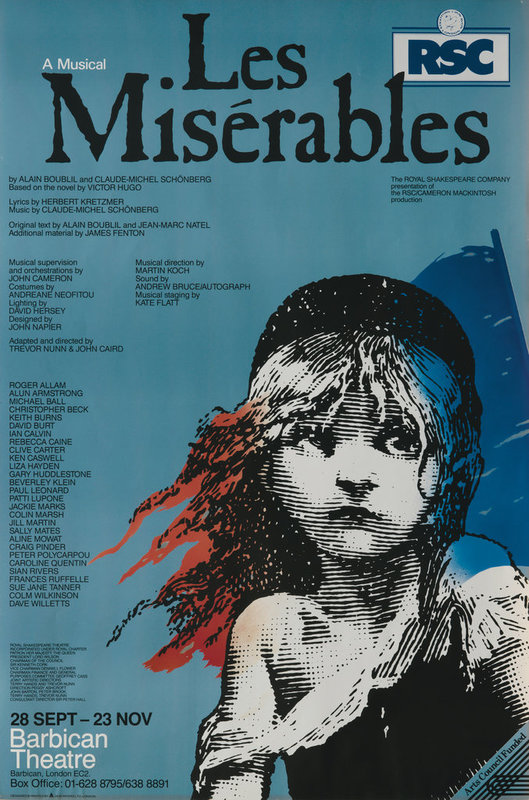 |
| 1985 Royal Shakespeare Company |

However, it was a monstrous effort, condensing 1200 pages into three acts, entirely in music with no spoken word. They streamlined the story, giving less background information about the characters than Hugo's gigantic work did, and in fact, less than most of the movies managed.
Money Then & Now

Using the ounce of gold as a standard up until the recording of currency value, and the Franc being .290 grams of gold from 1815-1850, we end up with one 1820's Franc being about $20 USD. You get an error allowance of plus or minus 26% depending on whether you use a European or American inflation index.
This means Valjean pays the Thenardiers between $25,000 and $40,000 for Cosette,
The average salary for a days labor was about 1 Franc, from what I could find (30 francs per month, $600 USD today, or about $1.60 per hour assuming a 12 hour day. That gives them an annual salary of $7,200 USD today per year (360 francs)
Some other prices: Admission to a public bathouse: 10 centimes (.10 francs, $2 USD)
Litre of milk: 5 centimes .05 francs (1 USD)
A Fancy Dinner: 1.50 francs ($30 USD)
Winter Coat: 50 Francs ($1,000 USD today)
Women's Dress: 60 francs ($1,200 USD today)
In 1861 (after the story), a Senator would make 15,000 francs/year ($300,000 USD today)

Fun Facts
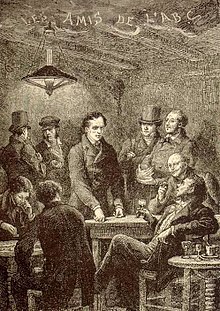 |
| The ABC Cafe |
Despite the fact that Marius's love for Cosette is really the main plot for the musical, little is seen of either student life or artist life. It is mentioned that it is mostly the students who lead the building of the barricades, but nothing is said about Marius's bourgeois upbringing, or about his grand-father, the Napoloeonic General. The writers did choose to leave the ABC Café, however, though the pun is lost on most of the public especially as it is never said aloud. The French name of the cafe is abaissés, which means"lowly" pronounced [abese] - which sounds in English like "ABC".

?Hurst & Blackett, the London publishers, not to be outdone by the master, produced the world’s shortest letter when they wrote back to Hugo on the firm’s letterhead:
!and did not sign it. Nobody could write anything shorter that would convey any meaning.

Read more about the history of the play, the truth behind the story, and its author Victor Hugo.
Text content courtesy of Wake Forest University professor Laurie Schafer.
Used under the Creative Commons Attribution-NonCommercial 3.0 Unported License.
Money Data
Used under the Creative Commons Attribution-NonCommercial 3.0 Unported License.
Money Data
Data: Prices of items: http://www.daumier.org/
Inflation index: http://www.davemanuel.
Price of Gold: http://www.davemanuel.
